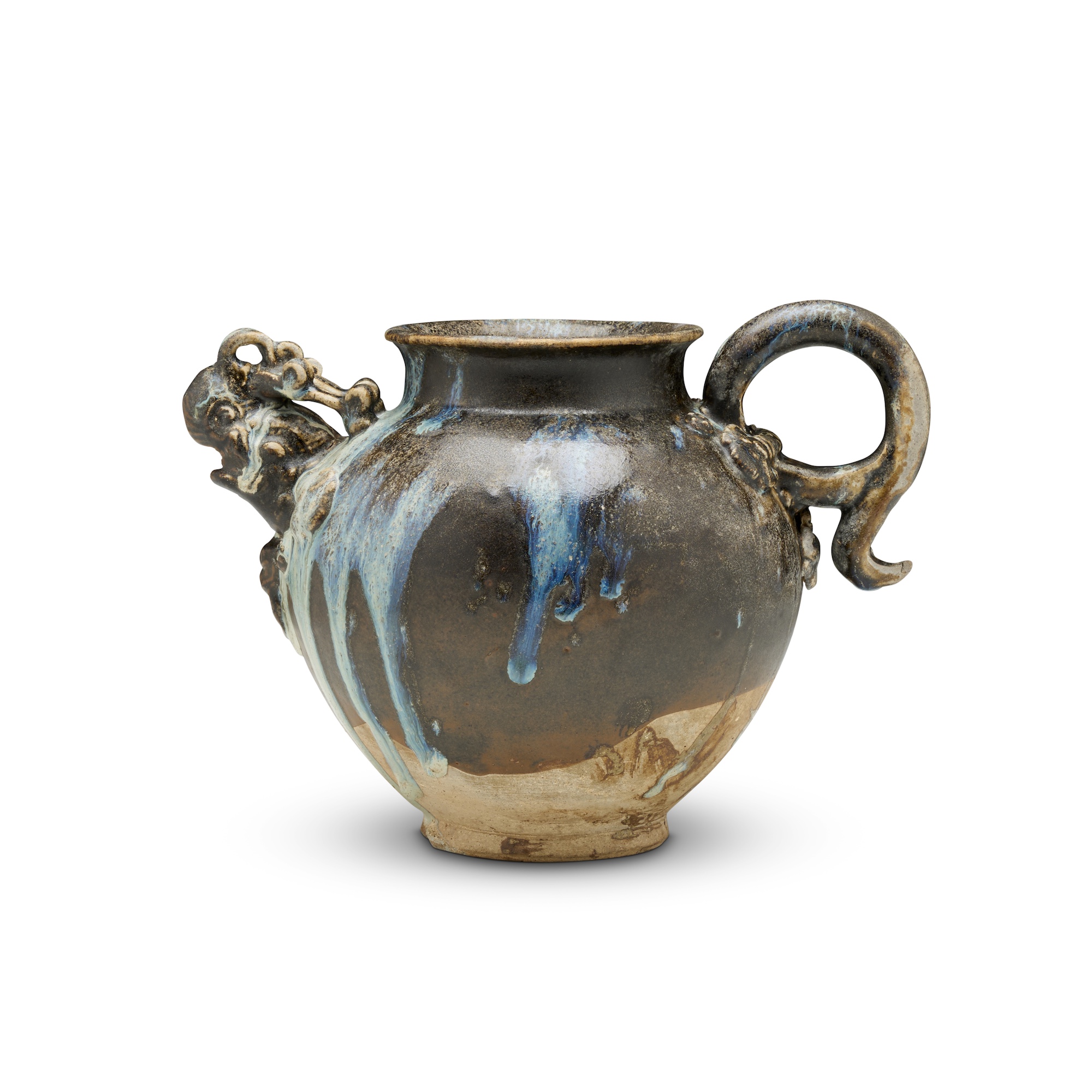
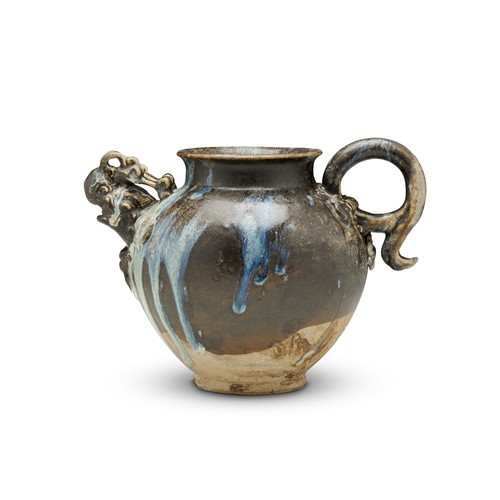
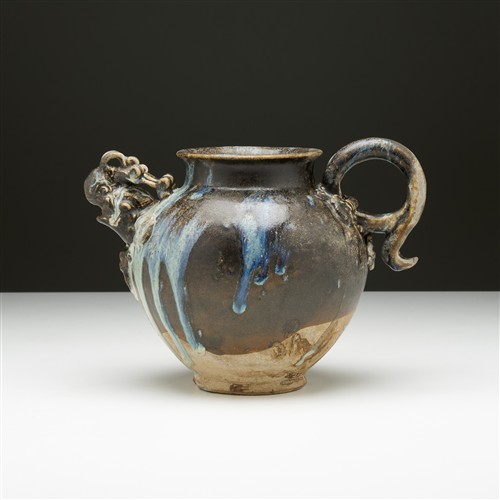
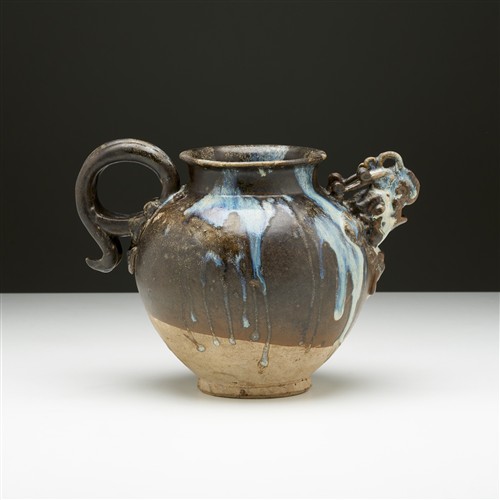
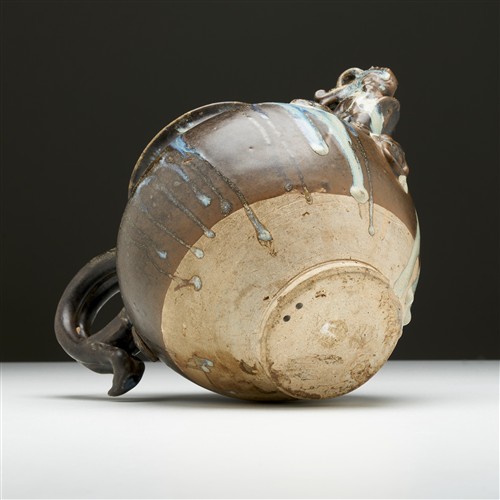
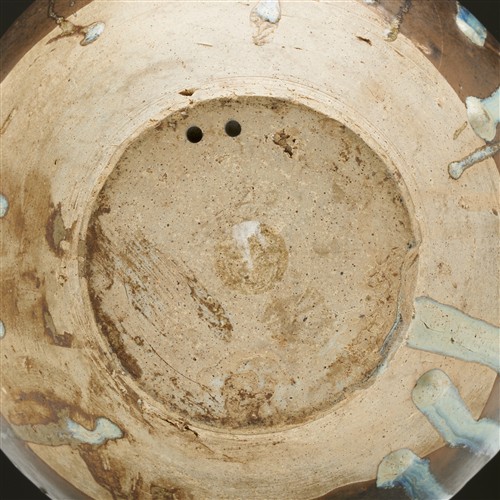
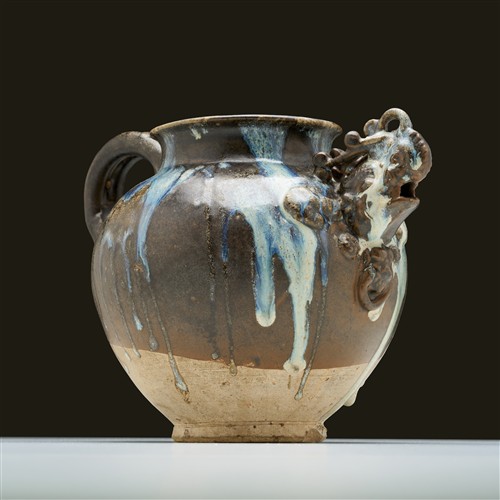
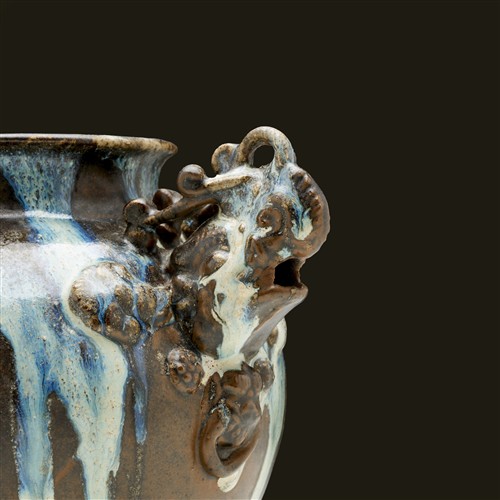
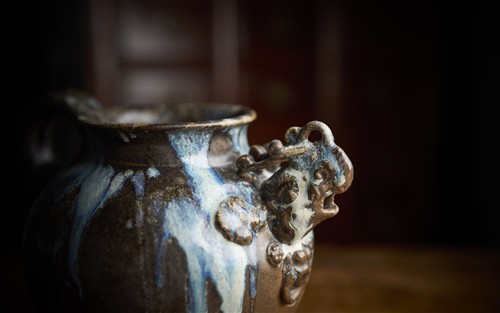
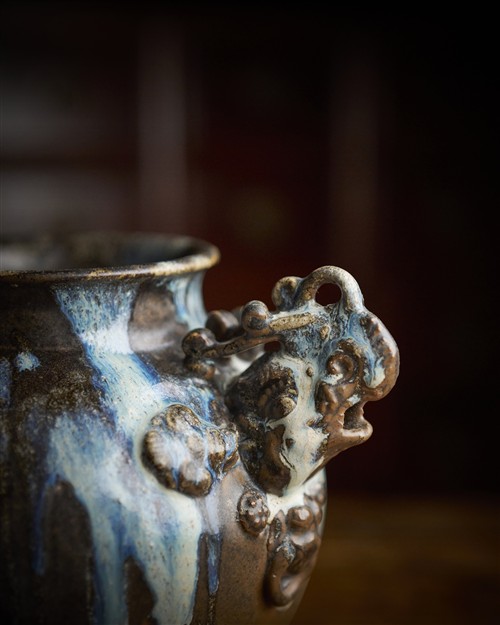
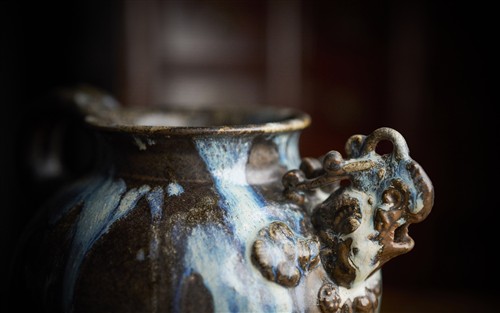
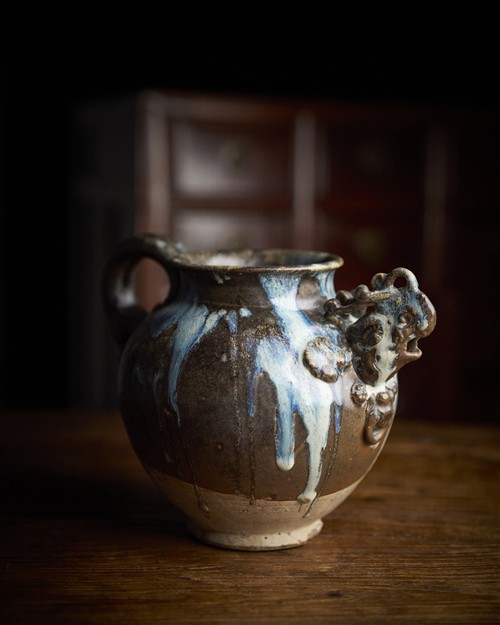
The ewer is potted with a compressed globular body, the spout ingeniously modelled as a makara head with three projecting horns and applied to the shoulder opposite a looped strap handle. The body is further enriched with a series of applied bosses surrounding the spout and handle. Covered overall with a rich chocolate-brown glaze, the interior is fully glazed, while the exterior glaze terminates irregularly above the foot, revealing the buff-coloured stoneware body beneath. Milky-white and pale cobalt-blue phosphatic streaks cascade freely over the surface, pooling unevenly around the lower body and onto the foot. The slightly splayed foot is neatly knife-cut and rests on a flat base.
The form of the present vessel is particularly noteworthy. The makara-head spout, loop handle, and the moulded decorative motifs suggest derivation from a metal prototype, most likely originating in Central Asia. During the Tang dynasty, foreign luxury objects entered China in unprecedented numbers through the Silk Road, profoundly influencing contemporary decorative arts. Ewers inspired by Sogdian and other Central Asian metalwork became especially fashionable, and the present example may be viewed as a ceramic reinterpretation of such prestigious imported models. The fantastical makara-head terminal, itself a motif transmitted across India, Central Asia, and China, further reflects the cosmopolitan artistic environment of the Tang empire.
Tang dynasty phosphatic-splashed ewers of this distinctive type are of the utmost rarity. Indeed, fewer than three examples with a makara-head spout appear to be recorded. The closest published comparison is a phosphatic-splashed ewer in the Arthur M. Sackler Collection, now preserved in the National Museum of Asian Art, Smithsonian Institution, Washington, D.C. (accession no. S2006.6), which shares the distinctive makara-head spout and applied ornamental details. The present example, however, differs in its more globular body and in the heightened dramatic effect of its darker blue and milky-white glaze splashes.
Further comparison may be drawn to a Tang dynasty sancai-glazed ewer with a similarly modelled makara-head spout in the collection of the Shanghai Museum. Although executed in the more familiar three-colour palette, the Shanghai example demonstrates the popularity of this exotic zoomorphic spout form among luxury ceramic wares of the Tang period. The present vessel is particularly important in translating this sculptural motif into the exceptionally rare phosphatic-splashed tradition associated with the Lushan kilns.
Additional related examples include a Tang dynasty phosphatic-splashed ewer with a straight spout and strap handle in the Palace Museum, Beijing, illustrated in Ceramics Gallery of the Palace Museum, Part I, Beijing, 2011, pp. 132-133, no. 75, and another example with a short straight spout in the Museum of East Asian Art, Bath, illustrated in The Museum of East Asian Art, Vol. I, cat. no. 30, p. 67. While these vessels demonstrate the development of the form within the Tang flower-wares tradition, neither possesses the remarkable zoomorphic makara-head spout of the present ewer.
Combining an elaborately sculpted makara-head spout, applied boss decoration, and richly variegated phosphatic splashes, the present vessel ranks among the rarest surviving products of the Tang dynasty Lushan kilns. Its distinctive form, likely inspired by Central Asian metalware, together with its highly experimental glaze treatment, embodies the cosmopolitanism and technical innovation that characterize the finest ceramics of the Tang period. Few comparable examples remain outside institutional collections, rendering the present ewer an exceptionally important survivor of the celebrated Tang flower-ware tradition.
The dating of the present ewer is supported by Oxford Authentication thermoluminescence analysis, Certificate no. P110g61, the results of which are consistent with manufacture during the Tang dynasty (AD 618-907).
唐代魯山窯花瓷馬卡拉首流執壺
此壺器身呈扁圓鼓腹,肩部一側塑貼馬卡拉(Makara)首形流,流首飾三角狀犄角,與後方環形帶狀把相對而設。流與把四周飾多組乳釘狀貼飾,使器身更顯立體繁麗。通體施濃潤巧克力褐色釉,內壁滿釉,外壁釉層則不及底,於下腹處呈不規則界線收釉,露出淺褐色石質胎。其上再施月白至淡鈷藍色磷酸鹽斑釉,釉汁自然流淌,沿器壁蜿蜒而下,並於近足處聚積流漫。圈足微撇,刀削修足俐落,平底。
本器造型尤為引人注目。其馬卡拉首形流、環形把以及貼塑裝飾細節,均顯示其設計很可能源自中亞地區金屬器原型。唐代藉由絲綢之路與西域諸國往來密切,大量異域工藝品及奢侈器物傳入中原,對當時藝術與工藝產生深遠影響。受粟特及其他中亞金銀器啟發而製作的執壺,於盛唐時期尤為流行,而本器可視為中國陶工將此類珍貴金屬器轉化為高溫瓷器的傑出例證。馬卡拉作為源自印度並經中亞傳播至中國的神獸形象,其出現亦充分反映盛唐兼容並蓄、海納百川的文化特質。
唐代魯山窯花瓷執壺本已極為罕見,而採用馬卡拉首流之例更屬鳳毛麟角。目前所知同類傳世品不逾三例。最接近之比較例為美國華盛頓史密森尼學會國立亞洲藝術博物館(National Museum of Asian Art)所藏原阿瑟.賽克勒(Arthur M. Sackler)舊藏花瓷執壺(館藏編號 S2006.6),其同樣採用馬卡拉首流並飾有相近之貼塑裝飾。本品則腹部更為飽滿圓渾,月白及藍色斑釉流淌更具層次與戲劇性效果。
另可比較上海博物館藏一件唐代三彩馬卡拉首流執壺,其流部造型與本器極為相似。雖施以典型三彩釉色,但足證此類異域神獸流口曾見於唐代高等級陶瓷器物之中。本品尤具研究價值之處,在於將此一充滿異域色彩的造型融入極為罕見的魯山窯花瓷體系之中。
其他相關例子可參見北京故宮博物院藏唐代花瓷執壺,著錄於《故宮博物院藏文物珍品大系.陶瓷館(上)》,北京,2011年,頁132至133,圖版75。另英國巴斯東亞藝術博物館(Museum of East Asian Art)亦藏有一件帶狀把花瓷執壺,著錄於 The Museum of East Asian Art, Vol. I, 圖錄30,頁67。上述諸例雖展現唐代花瓷執壺之發展脈絡,然皆不具本器極為罕見之馬卡拉首流裝飾。
集精妙雕塑化馬卡拉首流、貼塑乳釘紋飾及瑰麗流淌之花瓷斑釉於一身,本器堪列現存唐代魯山窯製品中最罕見之列。其造型所體現之中亞金屬器影響,以及奔放而富實驗性的釉色表現,共同彰顯盛唐時期的國際視野與製瓷技術創新。大多數可比較之例均藏於重要公共收藏機構,因此本器實為唐代魯山花瓷傳世器中極具學術價值與收藏意義之珍罕遺存。
牛津熱釋光檢測(Oxford Authentication)證書編號 P110g61,其檢測結果與本器斷代為唐代(公元618至907年)相符。
源流:
悉尼Raymond and Victoria Tregaskis 亞洲藝術舊藏,購於香港宋瓷。
26cm wide; 19 cm high
Estimate $50,000 - $70,000
A shallow chip to the foot rim, three very fine hairline cracks to the lower section, longest about 13.5cm.
The opinions expressed in the condition reports are a guide only and should not be treated as a statement of fact. Prospective buyers are encouraged to seek further information or request additional images during our pre-sale period where Leonard Joel staff are available for advice. Please note condition reports can be amended during the pre-sale period, so we strongly suggest any interested bidders check the published condition report available on the website before the auction commences. Leonard Joel makes no guarantee of the originality of mechanical or applied components. Absence of reference to such modifications does not imply that a lot is free from modifications.
Raymond and Victoria Tregaskis Oriental Art, Sydney, acquired from Ben Ng of Pan Pacific Arts Co., Hong Kong.
Important Chinese & Asian Art
AUCTION
Sale: LJ8825
11:00am - 25 October 2026
Hawthorn
VIEWING
Thurs 22 - Sat 24 October, 11am - 5pm
2 Oxley Rd, Hawthorn VIC
CONTACT
Luke Guan
luke.guan@leonardjoel.com.au
SIMILAR ITEMS
Lot 14
A VERY RARE PAIR OF CHINESE FAMILLE ROSE AND GRISAILLE-DECORATED 'LANDSCAPE' STOOLS, YONGZHENG PERIOD (1723 - 1735)
Estimate: $100,000-200,000
Lot 112
A CHINESE HIGH-FIRED WHITE-GLAZED CUP, SUI DYNASTY (581-618)
Estimate: $50,000-80,000
Lot 178
A CHINESE ARCHAIC BRONZE RITUAL VESSEL, ZUN, LATE SHANG/EARLY WESTERN ZHOU DYNASTY, 12TH-10TH CENTURY BCE
Estimate: $50,000-70,000
Lot 182
A RARE CHINESE YELLOW JADE OX, LATE SHANG DYNASTY, CIRCA 1250 - 1046.
Estimate: $40,000-60,000