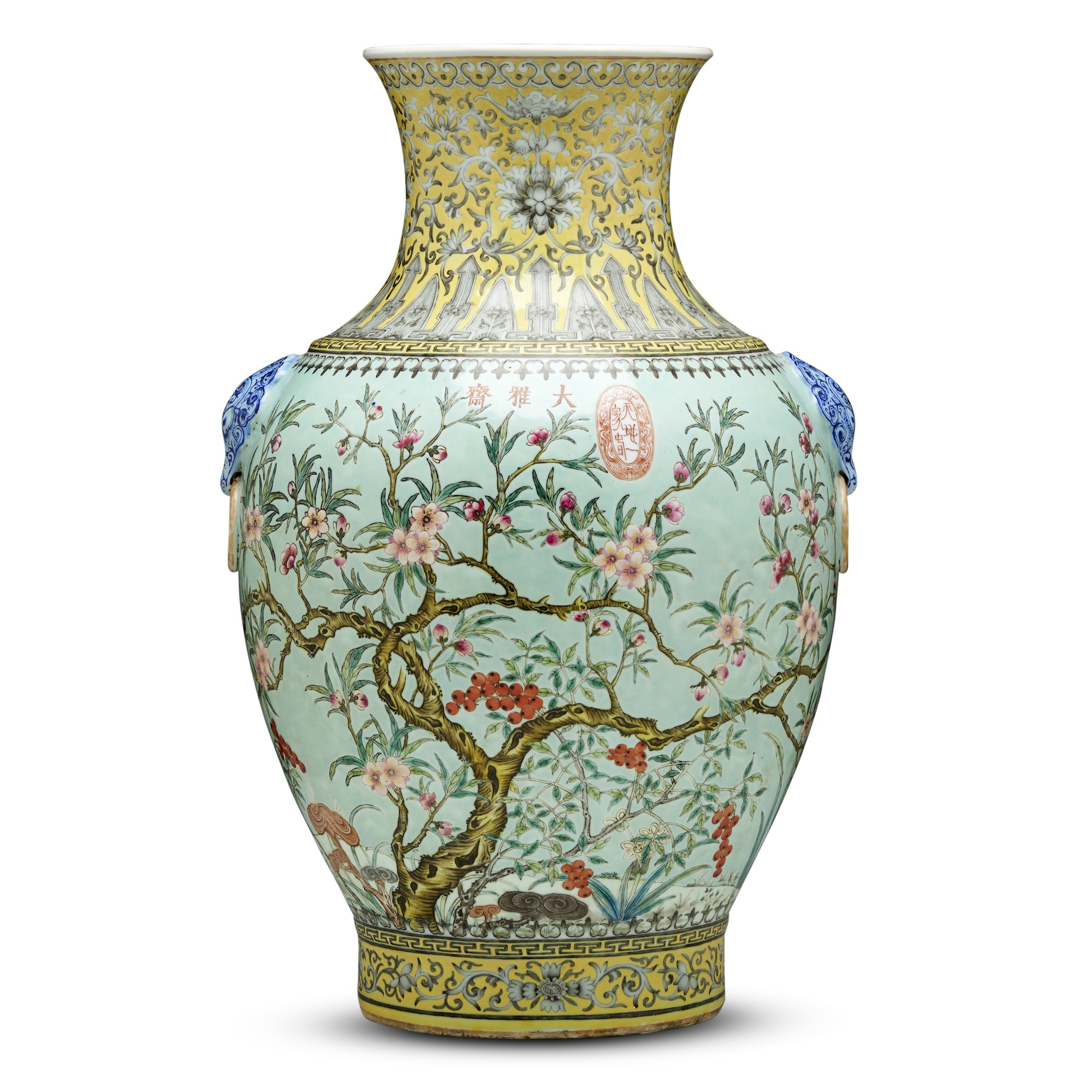
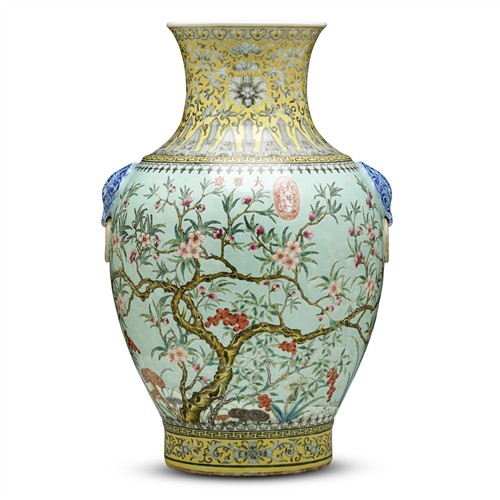
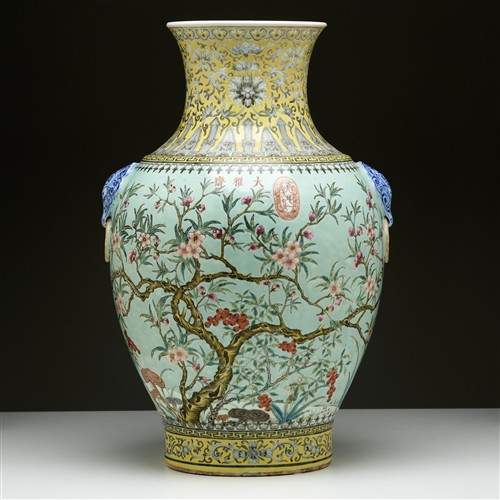
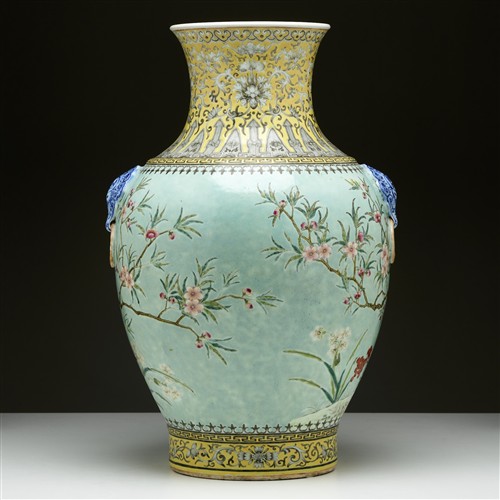
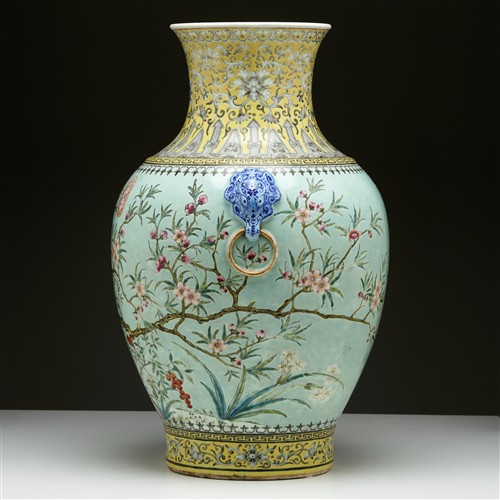
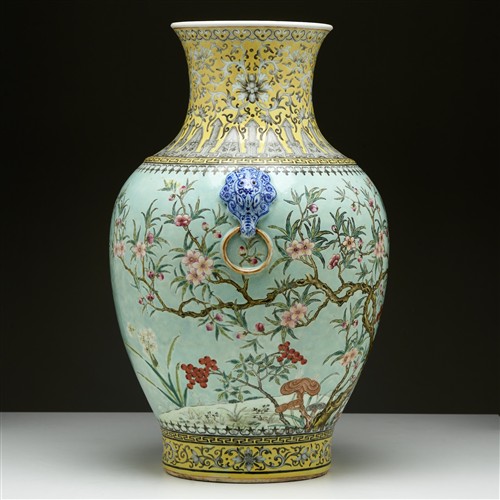
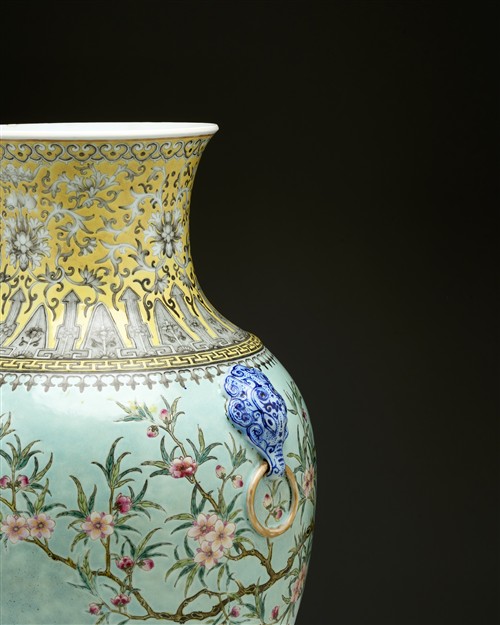
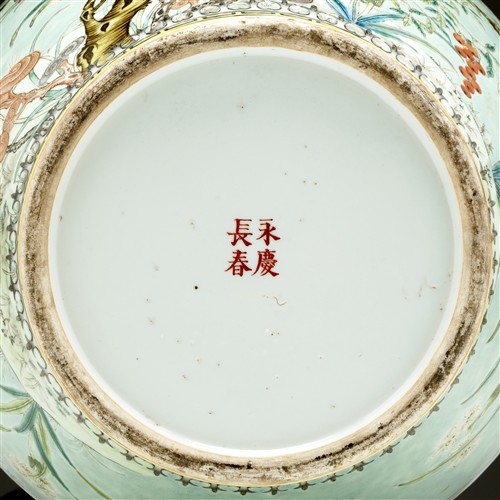
The unusually large vase of elegant baluster form finely decorated with leafy sprays of fruiting wisteria entwined around slender branches on which a single singing bird perches, the branches surrounding the three-character hallmark in iron-red, and a five-character seal mark enclosed by a border of two dragons pursuing a flaming pearl, the applied handles each shaped as a stylised blue-enamelled elephant suspending gilt ring-handles from its trunk, the neck with four grisaille lotus blossoms on a continuous foliate meander, two beneath a pendent bat and all beneath a band of ruyi head at the rim.
A similar vase in a yellow ground, see Christie's New York, 12/5/2017, lot 421.
清光緒(1875-1908)粉彩墨彩松石綠地花鳥紋大雅齋觀音尊 礬紅「永慶長春」四字款
52cm high
Estimate $20,000 - $30,000
Two very small areas on the mouth rim have been sprayed, otherwise, overall in good condition.
The opinions expressed in the condition reports are a guide only and should not be treated as a statement of fact. Prospective buyers are encouraged to seek further information or request additional images during our pre-sale period where Leonard Joel staff are available for advice. Please note condition reports can be amended during the pre-sale period, so we strongly suggest any interested bidders check the published condition report available on the website before the auction commences. Leonard Joel makes no guarantee of the originality of mechanical or applied components. Absence of reference to such modifications does not imply that a lot is free from modifications.
The Loh family collection, L.A., California, U.S.A., acquired from Singapore over 70 years ago.
A private collection, Sydney.
The mark "daya zhai" (大雅齋), 'Studio of the Greater Odes', is strongly associated with the Dowager Empress Cixi. Although no such hall has been located, a framed wooden plaque has been found in the Imperial Workshops bearing the three characters and with a seal reading "tiandi yijia chun" (天地一家春), 'The Whole World celebrating as One Family'. G. Xingkuan and W. Guangyao in Guanyang Yuci, Beijing 2007, pp.145-147 suggest that the distinctive porcelain services bearing the daya zhai mark were commissioned for the rebuilding of the Yuanmingyuan that commenced in 1873 during the reign of Tongzhi. However, R. Scott in For Her Majesty's Pleasure - Dayazhai Porcelain, Christie's Hong Kong, 3 December 2008, p.23, suggests that the porcelains were not produced until the Guangxu reign. Since the restoration of the Yuanmingyuan had been delayed by this time, the vessels would have simply been delivered to the Forbidden City instead.
Normally seen as a moment of renewed quality in Imperial porcelain production, Dayazhai wares continued to be produced into the very last years of the Qing Dynasty. The present lot seems to belong to a group of large archaic-form vases with Dayazhai palette enamelling that date to the early 20th century. The combination of grisaille enamelling and the red 'seal mark' lends the main decorative band a scholarly feel, evoking monochrome ink painting, and the design was reputedly taken from Cixi's own compositions of birds and flowers. The massive vase itself is of archaic form, modelled after a Spring and Autumn period bronze vase, hu, and further embellished with archaistic borders at the shoulder. Porcelain versions of this form are first seen in the mid-18th century, compare the present lot with an Imperial blue and white hu vase, Qianlong seal mark and of the period, in the National Palace Museum collection, illustrated in Blue and White Wares of the Ch'ing Dynasty II, Taiwan, pl. 2.
「大雅齋」款識,即「大雅齋」三字,與慈禧太后有著密切關聯。雖然迄今尚未發現名為「大雅齋」的實際殿堂,但在清宮造辦處曾發現一塊懸掛木匾,上書「大雅齋」三字,並鈐有「天地一家春」印章。耿興寬、王光堯於《官樣御瓷》(北京,2007年,頁145-147)中提出,帶有「大雅齋」款識的特色御瓷器應為同治年間(1862-1874)重建圓明園工程所訂燒的陳設瓷器。圓明園重建工程始於1873年。然而,羅拉.史考特(Rosemary Scott)於《For Her Majesty's Pleasure: Dayazhai Porcelain》(佳士得香港,2008年12月3日,頁23)一文中則認為,大雅齋瓷器實際上應至光緒朝方開始燒製。由於當時圓明園修復計劃已經延宕,故這批瓷器最終或僅送入紫禁城內廷使用。
長久以來,大雅齋瓷器一直被視為晚清御窯瓷器品質復興的重要代表,其燒造時間甚至持續至清朝覆亡前夕。本拍品應屬一組製於二十世紀初期的大型仿古式大雅齋彩瓷瓶。其主要紋飾帶以墨彩繪畫並配以朱紅印章式款識,富有濃厚的文人氣息,頗具水墨花鳥畫意境;據傳其紋樣更取材自慈禧太后親自繪製的花鳥稿本。
器形碩大,採用仿古壺(壺尊)式樣,原型可追溯至春秋時期青銅壺(Hu)器,肩部並飾仿古夔龍及幾何紋飾帶,進一步強化其青銅器風格。此類瓷質仿古壺式瓶最早見於十八世紀中葉,可參考臺北故宮博物院藏一件乾隆款及乾隆御製青花壺式瓶,載於《清代青花瓷器 II》,圖版2,其器形與本拍品頗為相近。
Important Chinese & Asian Art
AUCTION
Sale: LJ8825
11:00am - 25 October 2026
Hawthorn
VIEWING
Thurs 22 - Sat 24 October, 11am - 5pm
2 Oxley Rd, Hawthorn VIC
CONTACT
Luke Guan
luke.guan@leonardjoel.com.au
SIMILAR ITEMS
Lot 14
A VERY RARE PAIR OF CHINESE FAMILLE ROSE AND GRISAILLE-DECORATED 'LANDSCAPE' STOOLS, YONGZHENG PERIOD (1723 - 1735)
Estimate: $100,000-200,000
Lot 112
A CHINESE HIGH-FIRED WHITE-GLAZED CUP, SUI DYNASTY (581-618)
Estimate: $50,000-80,000
Lot 134
AN EXTREMELY RARE CHINESE HUSHAN WARE OVOID PHOSPHATIC EWER, TANG DYNASTY, 8TH/9TH CENTURY
Estimate: $50,000-70,000
Lot 178
A CHINESE ARCHAIC BRONZE RITUAL VESSEL, ZUN, LATE SHANG/EARLY WESTERN ZHOU DYNASTY, 12TH-10TH CENTURY BCE
Estimate: $50,000-70,000